
Social Work Programs from the University of Illinois Chicago
The Jane Addams College of Social Work at the University of Illinois Chicago leads the way in creating positive social change. US News ranks this institution in the top 10% of graduate social work programs nationally, making it an excellent choice if you want to become a social work professional.
The college builds on its namesake’s principles by adapting Jane Addams’ mission to today’s complex urban challenges. The institution focuses on educating professional social workers, building vital knowledge, and leading services that help vulnerable populations.
Students here learn to become competent and effective social workers who work with marginalized groups. The institution specifically helps poor and oppressed populations, racial and ethnic minorities, and other at-risk urban communities. This dedication to social justice runs through the college’s academic programs and research.
The college’s internationally recognized faculty and scholars make it special. Both faculty and students reflect Chicago metropolitan area’s rich racial and ethnic diversity. This creates a unique learning environment that prepares students to work in different community settings.
Students can choose from several academic paths at the Jane Addams College of Social Work to advance their careers and make a difference. The available programs include:
- Doctoral program leading to the Doctor of Philosophy in Social Work
- Master of Social Work degree program
- Joint MSW/MPH (Master of Social Work/Master of Public Health) degree program
Doctoral students can specialize in these interdepartmental concentrations:
- Black Studies
- Gender and Women’s Studies
- Survey Research Methodology
- Violence Studies
The college works with the Department of Criminology, Law, and Justice in the College of Liberal Arts and Sciences to offer the Interdepartmental Graduate Concentration in Violence Studies. This gives students complete training beyond traditional subject boundaries.
Students at Jane Addams College learn essential skills to assess, help, and evaluate different situations – whether they work with individuals, families, groups, organizations, or communities. Each class helps you respond better to real-life issues faced by people who need support.
You’ll work with people from different racial, ethnic, gender, social class, and age groups, as well as people with varying abilities and sexual orientations. You’ll learn about how racism, poverty, sexism, and other forms of discrimination affect people, and how to promote change for these groups.
Research is the substance of your practice at Jane Addams College. You’ll learn to assess policies and practices using evidence-based insights and turn research findings into practical solutions. This knowledge helps you create responsive organizations, programs, and policies that address community needs.
Social workers must understand how people behave in social contexts. You’ll learn how social dynamics shape behavior and community needs. Professional values guide your practice, following the National Association of Social Workers (NASW) Code of Ethics.
The Master of Social Work program requires applicants to have a baccalaureate degree from an accredited college or university. You need a liberal arts background with Social and Behavioral Sciences credits (20 semester/30 quarter hours) and must pass a statistics course with at least a C grade. Your final 60 semester hours of undergraduate study should have a minimum 2.75/4.00 GPA.
To apply, submit a personal statement, resume, official academic transcripts, and three reference letters. Transfer applicants must have interviews, while other candidates might need them. The Office of Admissions and Financial Aid must receive all materials by June 30 – no exceptions.
The MSW program needs 62 semester hours – 28 hours of Generalist coursework and 34 hours of Advanced Specialization coursework. This complete curriculum gives you both theory and practical skills for effective social work.
People choose Jane Addams College of Social Work because it offers excellent education in social work and social justice. The college provides academic rigor, hands-on experience, and values-based education to help you make a real difference in urban communities and beyond.
Where is University of Illinois Chicago located
The University of Illinois Chicago (UIC) sits in the heart of Chicago. Its urban campus gives students a chance to grow both academically and personally. The university’s central location creates a natural blend of education and city life.
Students find the campus on Chicago’s Near West Side, south of the culturally rich Greektown neighborhood. Downtown Chicago’s center lies just a 15-minute walk away. This prime spot lets students experience everything the third-largest city in the United States has to offer while keeping their own campus identity.
The campus neighbors the historic Little Italy/University Village area, which brims with Italian-American heritage. Generations-old homes, restaurants, and shops define this community. This mix of cultural history and academic spirit creates a special atmosphere where old meets new.
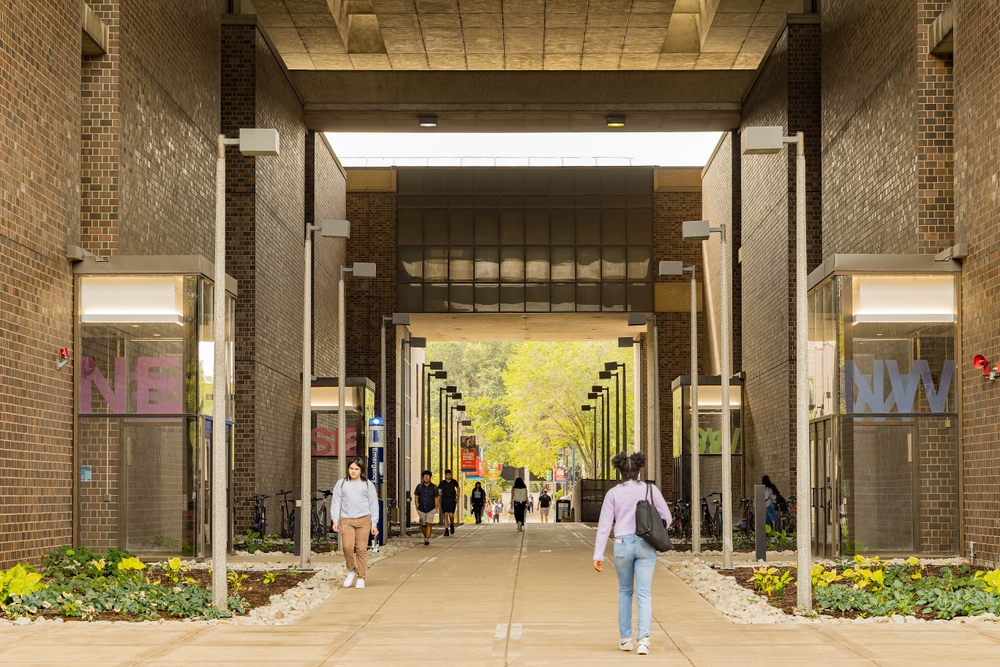
Two main areas make up the university grounds. The East Campus shows off Walter Netsch’s brutalist architectural style and serves as the main activity hub. The contrast between the university’s structured layout and the dense commercial surroundings came from Mayor Richard J. Daley’s urban renewal projects.
Key campus locations include:
- Student Center East: 750 South Halsted Street, Chicago, Illinois 60607
- Student Center West: 828 South Wolcott Avenue, Chicago, Illinois 60612
- Student Services Building: 1200 West Harrison Street, Chicago, Illinois 60607
Student Center East welcomes visitors from 6:30 AM to 9:00 PM every day, which works well with students’ varied schedules.
UIC’s location shines through its excellent public transit options. The Chicago Transit Authority’s Blue Line runs through the Eisenhower Expressway’s median along the campus’s north side. Three Blue Line stations connect directly to the university: UIC-Halsted, Racine, and Illinois Medical District. The UIC-Halsted stop stands just a block north of Student Center East.
The Pink Line serves the west campus on Polk Street and connects straight to Chicago’s Loop. Students can also reach Metra stations by walking or taking a short cab ride. These options help commuters from Chicago’s suburbs.
Students explore Chicago’s neighborhoods, cultural spots, jobs, and entertainment thanks to this reliable transportation network. UIC encourages them to use the city as part of their learning space and discover Chicago’s rich culture and resources.
Campus navigation became easier with UIC’s interactive map, which launched in August 2014 and got a fresh look in August 2021. The map runs on Google’s Maps API and shows detailed campus information. Users can find:
- Dining options
- Transit points
- Accessibility resources
- Academic services
- Cultural centers
- Financial services
- Health and wellness facilities
- Student services
- Additional support programs
UIC is Chicago’s biggest university with more than 33,000 students. Other sources back this up, noting UIC’s position as one of Illinois’s largest universities.
The Jane Addams College of Social Work benefits greatly from its city setting. Social work students get unmatched access to diverse communities, social service agencies, healthcare facilities, and policy organizations throughout Chicago. This big-city environment gives future social workers rich field opportunities and ground experience with urban social challenges.
Chicago’s diversity creates natural learning spaces for social work education. Students work directly with communities facing poverty, homelessness, immigration challenges, and healthcare gaps. Many social service agencies nearby bring guest speakers, site visits, and research partnerships that make learning more meaningful.
International and out-of-state students find UIC easy to reach. The campus lies about 16 miles from O’Hare International Airport and 10 miles from Midway International Airport.
The campus mirrors Chicago’s diversity, with 40% of UIC freshmen being first-generation college students. This mix helps future social workers learn alongside peers from different backgrounds, preparing them for work in varied communities.
Chicago offers social work students extensive networking and cultural opportunities. The city houses many social service organizations, advocacy groups, professional associations, and hosts conferences that add real value to classroom learning.
Chicago’s year-round activities make student life more enjoyable. Museums, theaters, restaurants, and festivals give UIC students plenty of ways to relax and grow beyond their studies. This balanced experience helps develop the viewpoint needed for effective social work.
UIC’s Chicago location creates the perfect setting for social work education. It combines academic excellence with city life in a place known for its diversity, culture, and social activism. Students leave not just with academic knowledge but as culturally aware practitioners ready to tackle complex social issues in any community.
The Jane Addams College of Social Work at University of Illinois Chicago provides a complete suite of social work programs. These programs create professionals who work with poor and oppressed populations. The graduates aim to ease poverty, oppression, and discrimination.
UIC’s social work education centers on the Master of Social Work (MSW) degree program, which has CSWE accreditation. Students learn vital knowledge, skills, and competencies they need for advanced social work practice. The MSW program’s structure includes a Generalist portion that builds basic views of social work practice. A Specialization portion then builds on this foundation.
Students can choose from several study options in the MSW program:
- Advanced Standing Option: Students with a CSWE-accredited Bachelor of Social Work (BSW) degree can finish in one academic year
- Full-Time Option: Takes two academic years to complete
- PM-Extended Study Option: Spans three academic years, with first-year classes scheduled late afternoon and evening to help working professionals
UIC’s social work education stands out by offering five specialized areas of practice to MSW students. Each path creates experts for specific populations:
The Child and Family specialization uses trauma-informed, strengths-based and family-centered practice. Graduates learn to deliver integrated services to children and families in community-based settings.
Students in the Mental Health specialization gain skills for specialized work in public and public-supported behavioral health settings.
The Organization and Community Practice (OCP) specialization develops advanced organizational and community practice skills specifically for urban communities.
The School Social Work specialization recognizes urban school systems’ vital role in improving at-risk urban populations’ quality of life. Students learn effective methods for educational environments.
The newest addition, Social Work within Justice Systems specialization started in Fall 2022. It teaches students to support and advocate for people affected by juvenile or criminal justice systems.
Field instruction placements play a significant role in the MSW program. Students get hands-on, real-life experience working with at-risk individuals, groups, families, and communities. They complete 450 hours during the Generalist year and 630 hours in the Specialization year.
UIC also offers a Joint MSW/MPH Degree Program with its School of Public Health. This program creates public health social workers ready to tackle health inequities in urban environments through prevention, intervention, research, and advocacy.
Students interested in public health social work benefit from this joint degree’s efficiency. They can earn both degrees in just three years while learning strategies to achieve health equity for disadvantaged populations.
The Jane Addams College’s PhD Program in Social Work develops scholars focused on social and economic justice. Students gain expertise in advancing social work treatment theory and research. They also learn to develop and direct social welfare programs.
Two broad research tracks exist in the doctoral program: social planning, policy and administration, and social work practice scholarship. Students then choose a more specialized area of study. More than 120 people have earned their doctoral degrees since the program began in 1973.
PhD graduates typically choose careers in:
- Teaching in colleges or universities
- Conducting and directing research
- Administrating large-scale social welfare programs
- Analyzing and advising on social policy
The doctoral program requires 96 total credits. Students get 32 hours of credit for their MSW and must complete at least 64 additional credits. These include required coursework at Jane Addams College, a qualifying examination, courses outside the college, electives, and dissertation credits.
UIC also offers a Post-MSW Professional Educator License (PEL) with School Social Worker Endorsement Program. MSW holders can become licensed school social workers through this non-degree program.
Students can get a PEL with School Social Worker Endorsement through the online curriculum. They gain real-life experience working with youth during an ISBE-required school-based internship.
Doctoral students can choose interdepartmental concentrations in Gender and Women’s Studies, Violence Studies, Black Studies, Latin American and Latino Studies, and Survey Research Methodology.
The programs’ interdisciplinary nature extends beyond traditional limits. PhD students can take courses at both University of Illinois campuses—Chicago and Urbana-Champaign. They can also participate in the Chicago Metropolitan Exchange, collaborating with Northwestern University, University of Chicago, and UIC.
Jane Addams College of Social Work stays true to its mission of preparing professionals who help poor and oppressed populations. The college works to ease poverty, oppression, and discrimination. This commitment to social justice runs through all courses and field experiences, honoring Jane Addams’ legacy.
The PhD program welcomes students with an MSW who show leadership potential and scholarly ability. Some candidates with advanced degrees in human service professions or related social sciences might also qualify.
Jane Addams College of Social Work keeps evolving to meet growing needs. The college responds to calls for better human services, social policy changes, and expanding social work education. Its diverse programs help graduates make lasting impacts in social work and their communities.
Field education at UIC
Field education is the foundation of social work learning at the University of Illinois Chicago. Social work educators call it their signature teaching method. Students turn classroom theories into practical skills through direct experience in real-life settings. The Jane Addams College of Social Work partners with more than 300 agencies, hospitals, schools and other organizations across the Chicago metropolitan area. These partnerships give students diverse chances to use their knowledge.
MSW students at UIC take their field placements with guidance from faculty. This experience ended up giving them the practical skills needed to work in social service networks. Students learn to improve living conditions and help individuals and families in their communities.
The field education program follows a well-laid-out structure based on program level:
- Generalist year MSW students must complete a minimum of 450 clock hours in field instruction
- Specialization year MSW students must complete 630 clock hours in field instruction
- Advanced standing students (those holding a BSW) complete one specialization field placement
Students can choose from several scheduling options. Generalist students usually take classes Monday and Wednesday. They complete field placement on two other days – often Tuesday and Thursday. This schedule allows 15-16 hours weekly at the placement site.
Specialization students follow a different schedule. They attend core classes Tuesday and/or Thursday (morning or evening) and spend about 21 hours per week at their placement. Most specialization students work at field sites Monday, Wednesday, and Friday.
Part-time MSW students in the PM Extended Study Program start field placement in their second year. They can choose from three schedules:
- September–May: 15-16 hours weekly with evening classes
- January–August: 15-16 hours weekly with spring evening classes
- May–August: 40 hours weekly for 12 weeks
PM students complete their specialization placement in their third year. They work at least 21 hours weekly, totaling 630 hours for the academic year.
Field work starts the second week of fall classes. Some organizations need students to finish training before school begins. Students continue their placement during winter break. The Jane Addams College asks students to plan a two-week break with their Field Instructor.
School Specialization students match their assigned school’s schedule instead of UIC’s calendar. They typically work from mid-August through mid-June.
Quality supervision plays a vital role in UIC’s field education. Field instructors need an MSW degree and at least two years of post-graduate experience. They should have worked at their agency for at least one year. Students get at least one hour of direct supervision each week.
Organizations might assign a Task Supervisor without an MSW. In these cases, students still need separate MSW supervision, either one-on-one or in groups. School Specialization field instructors must have both an MSW and a Professional Educator License (PEL).
The Jane Addams College pairs each Agency Field Instructor and student with a Faculty Field Liaison. Full-time clinical faculty serve as liaisons. They help students pick suitable field placements and track their progress. The college runs various orientations and workshops for Agency Field Instructors throughout the year.
Students often share stories about how field placements enrich their education. One mental health student worked at Habilitative Systems Inc. They provided therapy to outpatient clients, led treatment sessions for dual diagnosis, joined Health and Safety Council meetings, did assessments, managed cases, and handled administrative work. The student said, “This hands-on experience in many aspects of social work will shape my career choices in therapy for underserved urban populations”.
A student at Olive Harvey College Wellness Center in Chicago helped diverse students handle daily stress. They provided counseling and case management services to boost overall well-being and academic success. This experience taught them to “build trust with students by focusing on their strengths, working together, and respecting their cultural values”.
One generalist year student worked with Youth and Opportunity United (Y.O.U.), a nonprofit offering after-school services in Chicago’s northern suburbs. They checked in with middle school students and coached the after-school program.
Another student spent their generalist year at Advocate Christ Medical Center in the Inpatient Psychiatric and behavioral health unit. They conducted psychosocial assessments, planned discharges, ran group therapy, and held family meetings.
Most field placements are unpaid, but some partner agencies offer stipends. The college asks community partners to provide stipends when possible. Field liaisons can help students find these paid opportunities during their search.
Students stay registered for field placement during all terms. This complete structure ensures graduates have both theoretical knowledge and practical skills to help diverse populations.
UIC’s field instruction division sees this hands-on learning as essential to social work education. It brings together everything students learn. This approach to field education helps UIC create social work professionals ready to tackle complex urban community challenges.
What sets University of Illinois Chicago apart?
US News ranks the Jane Addams College of Social Work among the top 10% of graduate social work programs nationwide. The college stands out with unique features that draw students who want meaningful careers in social service.
The college shows a steadfast dedication to social justice. Social, racial, and economic justice shapes the curriculum, research initiatives and community activities. Students experience how theoretical knowledge applies to real-life situations through this mission-driven approach.
Faculty members make this college special. Internationally known researchers and scholars lead their fields. These professors bring years of hands-on experience that spreads through the curriculum. Students learn both theory and practical skills they need to work effectively.
Rich diversity runs through everything at Jane Addams College. Faculty and student populations mirror Chicago’s metropolitan area’s racial and ethnic makeup. Future social workers learn to work with different communities and tackle complex social problems from many views.
The college offers specialized training that sets it apart. Students can focus on working with specific marginalized groups. This targeted expertise goes beyond basic social work knowledge and makes graduates valuable to agencies serving vulnerable communities.
Research at Jane Addams College focuses on advancing social justice for disadvantaged populations. Their studies connect directly with community needs and create practical knowledge to improve services.
Chicago’s location gives students exceptional learning opportunities. UIC sits minutes from downtown, near Jane Addams’ Hull-House, giving students access to diverse urban experiences. Students find great field placements and community work because of their proximity to various populations and social service agencies.
The college’s history makes it unique. Jane Addams, known as America’s “mother of social work,” helped poor and immigrant families in Chicago. Today, the college continues her mission by addressing modern urban challenges.
Graduates leave well-equipped to make positive changes. They receive thorough academic training, extensive field experience, and develop a strong sense of social justice. These qualities help them work effectively with marginalized populations and push for systemic change.
Jane Addams College houses more child welfare experts than any other social work school nationwide. Faculty members study violence prevention through home visits, health disparities, youth development, school reform, community safety, and advocacy.
Programs and MSW field placements serve disadvantaged individuals and communities throughout Chicago’s metropolitan area. Communities get needed help while students gain great hands-on experience solving real social challenges.
Jane Addams College of Social Work represents more than just a school. It carries forward a tradition of social justice advocacy, community work, and evidence-based practice. The college combines academic excellence, diverse views, real-world experience, and dedication to marginalized populations. This combination creates graduates ready to solve complex social problems and drive positive social change throughout their careers.
Next steps
Jane Addams College of Social Work at the University of Illinois Chicago excels as a remarkable institution. You’ll find yourself among others who share your passion for meaningful social change. The college shows its steadfast dedication to social justice while preparing skilled professionals who serve vulnerable populations.
UIC’s social work program offers complete academic paths that match various career goals. The five specialized practice areas let you focus your education on specific populations and settings that line up with your professional dreams. Your learning experience’s turns theory into practical skills through ground application at more than 300 partner agencies.
The college’s strategic Chicago location becomes a great asset to your education. This urban setting gives exceptional access to diverse communities, social service agencies, and cultural experiences. These experiences improve your grasp of complex social issues. The college’s diverse faculty and student population create a rich learning environment that readies you for multicultural practice.
The complete curriculum at Jane Addams College will give you the tools to tackle complex social problems, even though applying your new knowledge might seem daunting at first. You start by building basic knowledge in the generalist portion. Then you develop specialized expertise through advanced coursework and targeted field placements. This well-laid-out approach helps you build the skills needed for effective social work practice step by step.
Jane Addams College of Social Work ended up offering more than just academic credentials. Students experience a transformative education that honors its namesake’s legacy while adapting to today’s challenges. The MSW, doctoral program, or joint degree options will welcome you into a community that champions social justice and improving lives. Your education’s true value shows in your ability to create positive change for people, families, and communities facing hardship.