Social Work Programs offered at Loyola University Chicago
The School of Social Work at Loyola University Chicago has been a vital part of social work education in the United States since 1914. The school has spent the last century as a dynamic force that drives social change and promotes social and economic justice for everyone – a mission that aligns perfectly with Jesuit values.
Loyola’s School of Social Work stands among the best social work graduate programs in the nation. The MSW program ranks in the top 2 social work graduate programs and #28 nationally. Students gain expertise that gives them an edge in their field. This ranking shows the school’s dedication to academic excellence and hands-on training.
Students learn to work at micro, mezzo, and macro levels through a detailed educational framework. This approach helps graduates handle individual cases and organizational challenges while promoting systemic change. The school’s Jesuit mission of cura personalis—care for the entire person—guides all educational activities.
Dean Patricia Findley, DrPH, MSW, LCSW, leads the School of Social Work. She earned her MSW from Loyola in 1989. Her leadership has brought fresh changes to the school. The MSW programs now require 49 credit hours instead of 60, making quality social work education more accessible and affordable.
The school’s faculty brings deep expertise to the social work field. Their research covers crucial societal needs like racial justice, climate change, immigration, and mental health. This work shapes their teaching and mentorship. Distinguished professors, clinical instructors, and specialists in social work practice types make up the faculty.
The school offers groundbreaking online programs, including the first fully Online Bilingual MSW degree in the contiguous United States. This program shows the school’s commitment to training culturally competent professionals who can work with Latine populations. Few peer institutions match this level of accessibility and cultural awareness.
Students get practical experience through internships in Chicago neighborhoods and beyond. These field placements let them use classroom knowledge in real situations while developing professional skills with supervision.
The school creates an environment that values diversity and inclusion. Students learn to respect differences in race, ethnicity, culture, class, gender, age, physical and mental ability, religion, immigration status, sexual orientation, gender identity, and gender expression. This inclusive environment prepares graduates to work with people from all backgrounds.
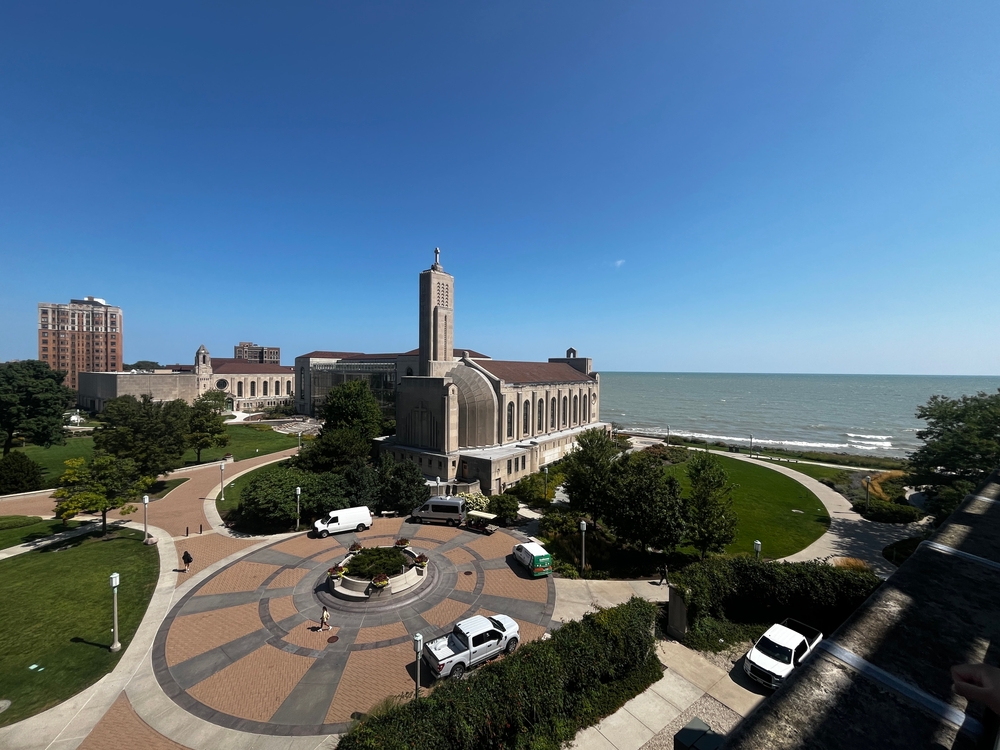
The School of Social Work sits in Chicago’s Magnificent Mile at Loyola’s Water Tower Campus, on the 5th floor of Maguire Hall at 1 East Pearson Street. This central location connects students to Chicago’s diverse communities and social service agencies.
Students become purpose-driven professionals, trusted partners, and transformative leaders through a practice-informed learning approach. Everyone at the school shares responsibility to champion social and economic justice, including anti-racist and anti-oppressive practices.
Faculty members work across disciplines on complex social and mental health issues, adding valuable knowledge to the field. Their research and scholarship go beyond regular degree programs.
The school works with partners in Chicago and around the world to improve individual lives, strengthen families, and build healthier communities. This work reinforces Loyola’s role as a catalyst for change toward a more just, equitable world.
The best candidates for Loyola’s programs care deeply about social justice and want to help transform lives and communities. They need emotional strength to handle complex challenges and excellent time management skills to balance their studies and internships.
Where is Loyola University Chicago located
Loyola University Chicago operates six distinctive campuses. Five of them are in the Chicagoland area, and one sits in Rome, Italy. Students in social work programs benefit from these learning environments and communities.
The School of Social Work calls the Water Tower Campus home at 820 N. Michigan Avenue. You’ll find this campus right next to Chicago’s famous “Magnificent Mile”. Social work students study at 1 E Pearson St, which puts them close to Chicago’s social service agencies, healthcare facilities, and community organizations. This location makes field placements and professional networking easier.
The Lake Shore Campus serves as Loyola’s main residential center at 1032 W. Sheridan Road in Chicago’s Rogers Park and Edgewater neighborhoods. Lake Michigan’s shoreline creates one of the Midwest’s most beautiful university settings. Students can reach this campus easily from the CTA Red Line at the Loyola “L” station.
The Health Sciences Campus sits at 2160 S. First Avenue in Maywood, Illinois. This location houses the Niehoff School of Nursing and the Stritch School of Medicine. The campus started in 1969 with the Loyola University Medical Center. Social work students interested in medical settings gain valuable resources here. Visitors can park in the Medical Center’s main Parking Garage A.
The Retreat & Ecology Campus (LUREC) adds another dimension to Loyola’s presence. Located at 2710 S. Country Club Road in Woodstock, Illinois, LUREC gives students space to reflect and build teams while studying environmental topics.
Loyola’s international presence shines through the John Felice Rome Center (JFRC) on Monte Mario in Rome, Italy. The campus found its permanent home in 1962 at Casa Italiana Viaggi Internazionali Studenti (C.I.V.I.S.), a former Olympic dormitory from the 1960 Summer Games. Students from Loyola and other schools study anthropology, archeology, art history, classical studies, communication, fine arts, history, global and international studies, peace studies, philosophy, and political science here.
The Water Tower Campus location matters most to social work students. This downtown setting creates perfect opportunities to work with Chicago’s communities and social service networks. Students gain hands-on experience through internships, research, and community work.
Loyola’s dedication to social justice education shows across all campuses. The School of Social Work’s position at the Water Tower Campus lets students see and tackle social issues directly.
The Chicago station on the CTA Red Line makes getting to the Water Tower Campus simple. Students from all over the metropolitan area can commute with ease.
Loyola’s campus layout reflects its educational approach. Students learn in urban centers, suburban healthcare facilities, and ecological retreats. Social work students benefit from exposure to different populations and social challenges.
Each campus upholds Loyola’s Jesuit values and social justice principles. These values shape the foundation of its social work programs. The university connects students with Chicago’s neighborhoods, cultures, and social service organizations.
The university lists 1032 W. Sheridan Rd, Chicago, IL 60660 as its main address. Each campus maintains specific offices and facilities that match its programs.
Future social work students will love the Water Tower Campus location. They’ll find many field placement options, easy public transportation access, and a diverse urban setting that teaches social work through real experience.
Loyola’s campus network throughout Chicago creates a unique learning environment. Students connect classroom concepts with ground practice settings. This mix of locations helps prepare social workers who can handle challenges in any community setting.
Loyola University Chicago’s School of Social Work equips students with detailed programs to prepare them for various social work roles. Each program combines coursework with practical field experience to create skilled practitioners who champion social justice, from undergraduate to doctoral levels.
The Bachelor of Social Work (BSW) program builds foundational knowledge through engaging coursework and fieldwork opportunities. Students learn about human behavior, social welfare policy, ethics, and diverse populations’ needs. BSW graduates can pursue careers in social services, including child welfare, community mental health, drug/alcohol rehabilitation, and developmental disabilities. This 100-year old program is an accredited beacon of excellence in social work education.
Students seeking advanced education can choose from multiple pathways to earn a Master of Social Work (MSW). The traditional MSW program needs 49 credit hours with two internships totaling 1,000 hours. Students complete it in two years of full-time study or four years of part-time study. U.S. News & World Report ranks the program #28 in the nation for graduate social work.
The MSW with Advanced Standing program welcomes students who earned their BSW degree in the last five years. This accelerated option requires just 23 credit hours and one 600-hour internship. Students finish in one year while maintaining the traditional program’s quality and accreditation standards.
Working professionals can choose Online MSW programs with traditional and advanced standing options. The Online Bilingual MSW program is the first of its kind in the contiguous United States. This unique program teaches students to work with Latine populations effectively.
The 5-Year BSW/MSW program ranks among the few combined programs in the United States. Students earn both degrees in just five years through this innovative pathway. The program costs less and remains available to more students. Junior year students start MSW coursework while paying undergraduate tuition.
The Ph.D. in Social Work program shapes leaders in practice and academia. Started in 1986, this 48-credit hour model takes two years of coursework plus comprehensive exams and dissertation work. Students blend research, theory, history, and practical aspects of organizational practice and teaching. Doctoral candidates finish all requirements within eight years of starting the program.
Loyola’s social work practice spans multiple disciplines through several Dual Degree Programs:
- MSW/MPH (Public Health)
- MSW/MJ (Children’s Law and Policy)
- MSW/JD (Law)
- MSW/MA (Social Justice)
- MSW/MA (Women’s Studies and Gender Studies)
These programs help students develop expertise in related fields and expand their career options.
MSW students choose between Micro Practice or Leadership, Mezzo, & Macro Practice (LMMP) specializations. Each specialization offers focused tracks:
- Micro Practice Specialization tracks include:
- Advanced Clinical Practice
- Certified Alcohol and Other Drugs Counselor Training Program (CADC)
- Migration Studies
- School Social Work/Professional Education License (PEL)
- Leadership, Mezzo, and Macro Practice (LMMP) Specialization features:
- Leadership, Community, Advocacy, and Policy (LCAP) Track
Working professionals can enhance their skills through Certificate Programs:
- Institute for Advanced Psychotherapy (post-MSW)
- School Mental Health Advanced Practice Program (post-MSW)
- Certificate in Alcohol and Drug Counseling
- Post-MSW Professional Educator License (PEL): School Social Worker Endorsement
The Illinois Certification Board accredits the CADC certificate program as an Advanced Accredited Training Program. Students learn to become Certified Alcohol and Other Drug Counselors.
Students gain experience through Loyola’s network of more than 1,000 partner agencies for internships and field placements. These connections build professional networks and let students apply classroom knowledge in ground settings.
The online Social Justice Certificate provides another path for social advocacy. This 15-credit-hour program works as a standalone certificate or counts toward Loyola’s MA in Social Justice. Students learn social advocacy, community organizing, and systemic social change skills.
The Council on Social Work Education (CSWE) accredits all Loyola’s social work programs. MSW graduates qualify to take the LCSW examination and practice as licensed clinical social workers. This accreditation ensures graduates meet national standards for professional practice.
Loyola’s School of Social Work shows its steadfast dedication to educating practitioners at every level. The school prepares professionals for entry-level positions, advanced clinical practice, leadership roles, and academic careers. These diverse pathways continue Loyola’s century-long mission of training social work professionals who serve vulnerable populations and advance social justice.
Field education at LUC
Loyola University Chicago’s social work programs consider field education their foundation. Social work education experts often call it the signature pedagogy. Students put their classroom theory to work in ground settings through practical internships and develop crucial skills under professional guidance.
BSW students must complete a detailed internship that requires a minimum of 400 hours. Their senior year includes a two-semester commitment across SOWK 330 and SOWK 340 courses. Students attend two full days each week. The experience helps them understand agency programs, services, and policies. They spend about 50% of their time directly serving clients.
MSW students face more demanding field education requirements. They need to finish two separate internships totaling 1,000 hours. Students start with a first-level generalist internship of 400 hours. They schedule this on Tuesdays and Thursdays while taking 500-level generalist courses. Next comes a second-level specialized internship of 600 hours. Students arrange this for Mondays, Wednesdays, and Fridays during their 600-level specialized courses.
Advanced Standing MSW students with a BSW earned in the last five years complete one 600-hour internship. This simplified process acknowledges their undergraduate field experience while helping them get necessary advanced practice skills.
Loyola’s field education stands out because of its scheduling flexibility. Students can pick from three timeframes:
- Fall to Spring (August to May)
- Spring to Summer (January to August)
- Summer Block (May to August, requiring 35-40 hours weekly)
Summer Block offers deep immersion. Students can finish their internship quickly by working full-time (30-40 hours a week). This option helps students with specific scheduling needs or those who want to speed up their practical training.
Loyola’s field education prioritizes quality learning experiences over just achieving hour requirements. Generalist internships help students master fundamental practice skills. These include paperwork administration, intake assessments, service documentation, case management, and research project participation. Second-level specialized internships build on these skills with advanced responsibilities.
The School of Social Work partners with over 1,500 agencies throughout Chicago and its metropolitan area. Students work with clients from various socioeconomic, racial, and cultural backgrounds. These mutually beneficial alliances create rich learning environments.
SONIA, the school’s internship management platform, makes the internship process easier. This online system helps students, Internship Supervisors, and Liaisons handle the entire internship process. They can document requirements and ensure successful experiences. Students research available sites, submit applications, and track their progress through SONIA.
Students gain valuable job-hunting experience through the internship selection process. SONIA allows them to submit applications and list up to five preferred internship sites. Agencies review student materials and invite candidates for interviews. Students often compete with peers from Loyola and other universities. This competitive process builds professional skills and matches students with suitable learning environments.
The school expects more than just completing required hours. Students should honor their agreements with agencies through the predetermined end dates instead of leaving early after reaching minimum hours. This approach reinforces professional responsibility and ethical practice standards.
Specialized dual-degree programs maintain field education’s importance while meeting specific needs. WSGS/Social Work Dual Degree students must complete two social work field placements that focus on women. These placements should provide experience with women-focused treatment methods or involve advocacy work on women’s issues.
Supervision plays a vital role in Loyola’s field education model. Social workers with MSW degrees must supervise all placements. This ensures students get guidance from qualified professionals and helps develop their skills through feedback and professional socialization.
Loyola University Chicago’s extensive field education program prepares social work students for professional practice. Students learn to address complex human needs in practice settings of all sizes. This blend of theory and practice gives graduates the tools they need to succeed.
What sets Loyola University Chicago apart?
Loyola University Chicago’s social work programs stand out due to several key factors that create an outstanding learning environment. The university’s Jesuit, Catholic values of social justice, personal care, and service to others form the foundation of its approach to social work education. These core values shape every student’s experience.
National recognition highlights the program’s excellence. U.S. News & World Report ranks Loyola’s Master of Social Work program #28 nationwide. The undergraduate program demonstrates even stronger performance.
Students benefit from close faculty interaction. The MSW program’s 1:12 faculty-to-student ratio means you get individual attention and guidance throughout your academic trip. Faculty quality strengthens this relationship – 92% have doctoral degrees in social work or related fields.
Loyola’s School of Social Work features one of the country’s largest internship networks. More than 1,500 partner agencies in Chicago and beyond provide unmatched professional experiences. These partnerships include healthcare facilities, immigrant and refugee groups, schools, government offices, and social service organizations.
The program’s accreditation record shows its dedication to quality. The Council on Social Work Education has accredited the MSW program since 1921, while the BSW program has managed to keep accreditation since 1976. This long-standing accreditation means your degree meets strict professional standards.
The university makes advanced education more available through innovative program structures. Students can earn both BSW and MSW degrees in five years instead of six through one of America’s few combined programs. The school also improved its MSW program by reducing credit requirements from 60 to 49 hours. This makes quality social work education more achievable without compromising standards.
Innovation extends to specialized programs. Loyola offers the mainland United States’ first fully Online Bilingual MSW degree. This program helps graduates work effectively with Latine populations and addresses mental health service gaps for immigrant and refugee communities.
Student success on licensing exams proves the program’s effectiveness. First-time pass rates exceed national averages – 82% for LSW and 79% for LCSW exams. These numbers show how well the program prepares students for professional practice.
Research opportunities at Loyola include students at every level. The Research and Innovation Lab (RAIL) gives undergraduate and graduate students real-life research experience with faculty mentors. Students tuck into research questions, review literature, analyze data, write manuscripts, and present at conferences.
Faculty research combines practice, human focus, and empowerment. With 67% of tenure-track faculty having active grant funding, students learn in an environment where research improves classroom and field experiences.
Social justice remains central to the program’s mission. Faculty and students assess power and privilege distribution to strengthen social, racial, economic, and environmental justice. Students learn about societal and historical roots of injustice to implement ethical, culturally informed, anti-racist, and anti-oppressive practices.
Loyola’s social work education develops professionals who work at multiple practice levels:
- Micro-level – Providing direct services to individuals and families
- Mezzo-level – Working with groups and organizations
- Macro-level – Engaging in community organization, policy development, and system-level change
The program’s scholarship opportunities make it special. Loyola offers need-based scholarships to international, DACA, and undocumented students, showing its commitment to diversity and accessibility.
The program’s strength comes from combining academic excellence with Jesuit values and social justice principles. Dean Patricia Findley explains, “In the profession, we often talk the talk about caring for the whole person. As a school of social work within a Jesuit institution, we can actually walk the walk because we are mission-centric in all that we do and we really would like a person to be taken care of holistically”.
This integrated approach creates graduates who become agents of change. They leave the program inspired, informed, and ready to make meaningful differences in their chosen careers.
Next steps
Are you ready to start your social work education at Loyola University Chicago? The admissions process helps you show your strengths as a future social work professional in a clear and complete way.
The School of Social Work lets you start your program at different times throughout the year. The MSW program has these application deadlines:
- Fall Semester: June 1 – The program might still accept applications after this date until all spots are filled
- Spring Semester: November 1 – The program might still accept applications after this date until all spots are filled
- Summer Semester: May 1 – The program might still accept applications after this date until all spots are filled
Getting an internship is crucial to the MSW program. While you can submit applications after these deadlines, internship spots aren’t guaranteed for late applicants.
Students who want to join the MSW with Advanced Standing program and follow the School Social Work Track need to apply by April 1. This ensures they get an internship placement when fall term begins.
The Ph.D. in Social Work program only starts in fall, and applications are due by January 1.
Your application needs these important pieces:
- Official transcripts from every school you’ve attended (sent straight to Loyola from your schools)
- Two references
- Resume or CV
- Statement of Purpose
Your personal statement plays a big role in your application. You’ll need to write 1,500 words, double-spaced, about why you want to study social work and what draws you to Loyola’s MSW program. This statement shows the admissions team how well you write and think critically, plus your self-awareness – skills you’ll need for graduate studies and supervised practice.
Students whose first language isn’t English must take an English proficiency test. Students with degrees from outside the U.S. need their transcripts evaluated officially.
Loyola’s BSW students who want to join the 5-Year MSW program must:
- Have a 3.0 GPA when senior year starts
- Finish their BSW by summer’s end
- Apply to the 5-Year MSW program during senior year
Fall graduates who want to start in spring should apply by September 15th of senior year. Spring and summer graduates planning to start in summer or fall need to apply by December 1st of senior year.
The School of Social Work hosts many events to help you learn more. You can go to graduate open houses, info sessions, one-on-one meetings, and open Zoom calls. These events are a great way to get to know the programs and meet faculty and current students.
Undergraduate students can schedule campus visits through the university’s website. Loyola’s admissions team helps students through every step from their first question to their final application. When you’re ready to move toward your social work future, submit your application online.