Social Work Programs at Aurora University
Aurora University’s prestigious legacy in social work education spans several decades. Their social work programs rank among the best in the region. The university has trained qualified social workers since the 1970s. The school’s social work roots trace back to a small human services college founded during the Great Depression in Chicago’s Hyde Park neighborhood.
The George Williams School of Social Work at Aurora University has achieved continuous accreditation by the Council on Social Work Education since 1969. This 50+ year old accreditation highlights the program’s steadfast dedication to high educational standards and professional excellence.
Students who choose social work at Aurora University begin a journey with expert faculty through comprehensive coursework. The program builds important professional connections and experiences that lead to immediate career success after graduation.
What Social Workers Do
Social workers are vital community resources who help people solve and cope with problems. These professionals blend intellectual capacity with emotional strength to make a difference in people’s lives. Social workers deeply care about:
- Human dignity and social justice
- Strengthening individuals, families, and communities
- Making positive changes in society
Social work includes child welfare, addiction treatment, mental health services, advocacy, aging services, family support, education, community organizing, and public policy. Communities increasingly recognize social workers’ essential role, leading to high growth in this dynamic profession.
Academic Foundation and Specialization
Aurora University’s social work curriculum starts with strong liberal arts foundations. This core education develops essential organizational and communication skills that are the foundations for field success. Master’s level students receive robust academic training in clinical social work practice with options for specialized study.
Bachelor of Social Work students begin their professional and clinical immersion in junior year. They explore social welfare and social justice issues while developing strategies for working with diverse populations. Students can transfer in or out of the program without losing credits until their junior year begins.
Curriculum Tracks and Certifications
Aurora University offers specialized tracks within its social work programs. Undergraduate students can choose from tracks like:
- Child Welfare – focused on protecting children’s health and well-being
- Addictions – preparing you to help people overcome substance abuse issues
The university offers coursework for valuable certifications including Certified Alcohol and Drug Counselor (CADC) and Co-Occurring Substance Use and Mental Health Disorder Professional (CODP I). Aurora University is the only university offering complete preparation for the CODP I Board Registration.
Program Flexibility
Aurora University’s social work programs adapt to modern life’s requirements. Master’s level students benefit from multiple start dates (fall, spring, and summer) with daytime, evening, and online options. This flexibility helps students pursue their degree while managing other commitments.
The university pioneered employment-based internships that let students use their current employer for fieldwork experience. This innovative approach has created partnerships with over 50 organizations. Students can work full-time while earning field credit.
Career Pathways
Aurora University’s social work education creates diverse career opportunities. Bachelor’s degree holders can pursue case management positions in nonprofit organizations, hospitals, or social service agencies. Two years of work experience qualifies graduates to take the Illinois State Social Work license exam.
Master’s degrees expand career horizons significantly. Graduates work as case workers in mental health agencies, homeless shelters, disability resource centers, domestic violence shelter services, immigration and refugee resettlement services, and senior citizen support agencies. The MSW program prepares students for clinical social work practice to help individuals, families, and communities while promoting social change for vulnerable populations.
Program graduates start successful careers right after graduation in general social services, addictions treatment, health services, rehabilitation, child and family welfare, youth services, geriatric services, juvenile justice, shelter services, or refugee resettlement.
Where is Aurora University located
Aurora University’s main campus is home to its well-known social work programs. Located in Aurora, the second-largest city in Illinois, the campus gives future social workers a perfect setting to build their skills in a bustling community.
The campus sits just 45 miles from downtown Chicago. This sweet spot gives students the best of both worlds. They get access to big-city internships and jobs while enjoying a friendly suburban environment. Social work students find this location perfect for field work and building professional networks.
The main campus spans 40 acres in a beautiful residential area on Aurora’s southwest side. You’ll find it at 41°45′17″N 88°20′52″W in Kane County, Illinois. The street address is 347 S. Gladstone Avenue, Aurora, Illinois 60506.
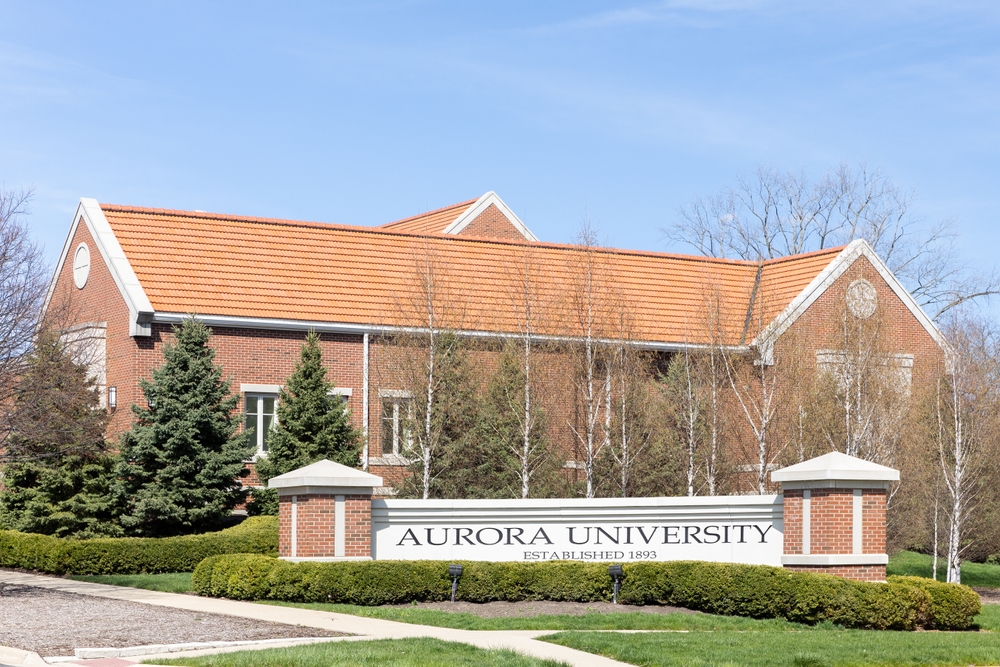
Red-tiled roofs catch your eye as you walk around campus. Charles Eckhart made these a must-have feature in his original campus donation. These distinctive roofs give the university its unique look.
The campus boasts 29 buildings for teaching, administration, and student housing. Students have access to six residence halls, sports facilities, and the Phillips Library. These spaces make life better for everyone studying social work and other subjects.
Campus buildings wrap around a traditional quad and nearby areas. This layout creates natural spaces where students and faculty connect. Social work students really benefit from this design since their field focuses on building relationships and communities.
Life near the Fox River Valley adds something special to the student experience. The area’s natural beauty offers great outdoor activities. This helps balance out the emotional demands of social work studies.
In spite of that, Aurora University believes location shouldn’t limit anyone’s access to advanced social work degrees. The school reaches more students through several other locations:
- University Center at McHenry County College – You’ll find this satellite campus at 222 Church Street in Woodstock, Illinois 60098. It offers selected undergraduate and graduate programs. Students from McHenry County and nearby areas can easily attend classes here.
- School District Partnerships – Graduate degrees in education are available at school districts throughout northern Illinois. These partnerships bring Aurora’s expertise right to where professionals work.
- Online Programs – AU Online makes many programs available from anywhere. Working professionals love this flexible option while pursuing their master’s in social work.
The university welcomes campus visits from potential students interested in social work programs. You can find directions and maps on the university’s visit page. Nothing beats seeing the campus in person to picture yourself studying here.
Multiple locations show how committed the school is to making quality social work education available everywhere. The main Aurora campus remains the hub for most programs, especially the Master’s in Social Work.
Social work students get some real advantages from Aurora University’s location:
- Community Engagement Opportunities: Local communities offer varied settings for field work and research.
- Professional Networking: Chicago’s proximity connects students with major social service agencies, healthcare systems, and government organizations.
- Cultural Diversity: Students work with different populations and social contexts—key for developing cultural awareness in social work.
- Work-Life Balance: Suburban living costs less than big cities, which helps students manage their education expenses.
The campus design, location, and multiple sites show how Aurora University creates an environment where future social workers can excel in their studies. Students start building professional connections that last throughout their careers.
Aurora University equips students with complete social work education at various levels. Students can choose from undergraduate to graduate studies that provide both foundational knowledge and specialized training.
The Bachelor of Social Work (BSW) program spans four years and builds a foundation for entry-level social work practice. This CSWE-accredited program starts with liberal arts education in the first two years. Professional orientation follows in the third and fourth years. Students can transfer in or out until their junior year without losing credits.
The School of Social Work offers several Master of Social Work (MSW) degree paths with flexible schedules. Students can pick between two-year full-time and three-year part-time programs. Full-time students take 15 semester hours for four semesters. Part-time students complete nine semester hours in the first four semesters and 12 semester hours per semester in year three.
BSW holders from accredited institutions might qualify for Advanced Standing MSW. This faster track values your previous social work education and works with both full-time and part-time schedules. Full-time advanced standing students finish 15 semester hours for two semesters plus three summer semester hours. Part-time students take six semester hours each semester in year one and nine semester hours each semester in year two.
Clinical social work practice stands at the heart of Aurora’s MSW program. Students learn to help individuals, families, and communities while promoting social change for vulnerable populations.
Curriculum Structure and Specializations
Aurora University’s undergraduate and graduate social work programs let you customize your education through specialized tracks:
BSW Specialization Tracks:
- Child Welfare – focusing on protecting children’s health and well-being
- Addictions – preparing you to help people overcome substance use disorders
MSW Specialization Tracks (available both on-campus and online):
- Addictions
- Child Welfare
- School Social Work
- Forensics
- Generalist
- Gerontology
- Health Care
- Leadership Administration
- Military and Veteran Social Work
Some tracks lead to professional certifications. The BSW Addictions track prepares you for the Certified Alcohol and Drug Counselor (CADC) certification. The MSW School Social Work track qualifies you to apply for an Illinois Professional Educator License with School Social Work Endorsement.
Innovative Dual Degree Options
Aurora offers trailblazing dual degree programs that expand professional capabilities. The Dual Master of Social Work/Master of Public Administration (MSW/MPA) program serves as a prime example. This path suits professionals who want to work in government, public sector, nonprofit, or social service agencies that need both social work expertise and leadership skills.
Students can complete the MSW/MPA program with 54 semester hours (with advanced social work standing) or 84 hours (without advanced social work standing). Admission requires meeting MSW program standards and receiving guidance from both Social Work and MPA programs.
Field Education: Applying Theory to Practice
Field education forms the foundation of Aurora University’s social work programs. Students apply classroom knowledge in ground settings with professional guidance.
BSW students spend about 15 clock hours weekly (225 clock hours per semester), totaling 450 clock hours yearly. First-year MSW students complete at least 15 clock hours weekly over two semesters, reaching 450 cumulative hours. Second-year students dedicate approximately 20 clock hours weekly over two semesters, accumulating 600 minimum hours.
Aurora’s field education features an employment-based internship option. Students can use their current workplace for fieldwork experience, with over 50 partner organizations supporting this arrangement.
Flexible Program Formats
Aurora meets diverse student needs through multiple program formats:
- On-campus at the main Aurora location
- At University Center at McHenry County College in Woodstock
- Online programs for both BSW and MSW degrees
Online options work great for busy professionals. Aurora offers Chicagoland’s only CSWE-accredited online Bachelor of Social Work program. The online MSW program is the region’s only CSWE-accredited Master of Social Work program in a fully online format.
Accreditation: The Mark of Quality
The Council on Social Work Education’s Board of Accreditation has accredited both BSW and MSW programs. This accreditation serves as the sole recognized standard for social work education in the United States and its territories.
CSWE accreditation guarantees program quality and adequate resources. Students graduate with verified competence and program quality assurance.
Aurora University provides accredited, flexible, and specialized social work programs at both undergraduate and graduate levels. Programs accommodate various life circumstances and career goals while preparing students for diverse professional paths.
Field education at AU
The foundation of Aurora University’s social work education lies in its field experience program. This program bridges classroom theory with ground application. Your social work experience at AU gives you hands-on training to build critical professional skills under expert guidance before you start your career.
Hour Requirements and Structure
BSW students at Aurora University must complete a substantial 450-hour internship at one of more than 1,300 social service field sites. Students do this field placement during fall and spring semesters of their senior or final year. Students in the Addictions Track need to complete at least 500 hours.
MSW program requirements vary based on your pathway. First-year students must complete at least 15 clock hours of field instruction each week over two semesters. This adds up to 450 total hours for the academic year. Second-year students step up their hours to about 20 weekly across two semesters, reaching a minimum of 600 cumulative hours.
Students with a BSW degree qualify as advanced standing and need just one 600-hour internship, whatever track they choose. Each field placement runs through two consecutive semesters. This creates a 32-week detailed training experience in your chosen specialization.
Placement Process and Support System
Aurora University helps you find your social work internship, but you take the lead in the process. The university uses Tevera, a specialized system with a detailed database of partner sites. This platform lets you:
- Search sites by ZIP codes to find opportunities in your area
- Use tags to find sites that line up with your track or interests
- Get contact details to reach out to potential field sites directly
The MSW Field Resources page on Brightspace shows current openings where sites want interns. The sort of thing I love about this program is its flexibility – you can interview with any organization you like in your community and potentially add them as a new site.
After getting accepted to an internship, you’ll create a learning agreement. This agreement shows how you’ll work on each social work competency during your experience. Think of it as your roadmap for professional growth during the placement.
Employment-Based Internships: A Distinctive Feature
Aurora University leads the way with employment-based internships. You can use your current workplace for fieldwork experience. In fact, over 50 organizations partner with AU. This lets students work full-time while earning field credit. Working professionals pursuing advanced social work degrees find this approach particularly helpful.
Your work activities must match the required competencies in the application to qualify. You’ll also need a field instructor at your site (someone different from your supervisor) and weekly one-hour supervision focused on your internship tasks.
Notable Field Placement Sites
Aurora University partners with field sites of all types where students learn about working with individuals, families, and communities. Popular internship locations include:
- Association for Individual Development
- Breaking Free
- Communities In Schools
- Gateway
- Hesed House
- Jennings Terrace
- Senior Services Association
- State Representative’s office
- West Aurora High School
- World Relief
These placements launch successful careers. Our graduates work at Big Brothers Big Sisters of America, county health departments, Department of Children and Family Services, Northwestern Medicine, and many other respected social service agencies.
Learning Components and Academic Integration
The social work curriculum at Aurora University centers on field instruction. Each student works at one agency with guidance from an approved field instructor who has an advanced degree. Students also take field instruction courses that add academic structure to their hands-on learning.
BSW field students meet weekly with peers and their Field Liaison/Course Instructor to discuss their learning through the field seminar course sequence. The field course includes several key tasks: Learning Agreement, weekly discussion forums, monthly time logs, virtual site visits, and progress evaluations.
Field Education Timeline and Expectations
The field placement application deadlines are:
- Summer start: January 6-March 1
- Fall start: April 1-June 1
- Spring start: September 1-November 1
Students must stick with their internship site for the full 32 weeks. This rule applies even if you complete your required hours early. Social work values reliability and dedication to client populations highly.
Your field liaison will help if you face any challenges during your internship. They’ll guide you through next steps and help solve problems with your site.
Aurora University’s field education offers practice settings in many areas. This reflects the variety of social service agencies where you can start your career. This well-laid-out experience helps you build and polish practical skills. You’ll also make valuable professional connections that often lead straight to job opportunities.
What sets Aurora University apart?
Aurora University’s social work programs stand way beyond the reach and influence of typical educational offerings. These programs trace their roots to a small human services college from the Great Depression era and have grown into the region’s most respected social work education options.
The George Williams School of Social Work at Aurora University has managed to keep continuous accreditation by the Council on Social Work Education since 1969. This long-running accreditation brings substantial benefits. CSWE-accredited programs are the only ones states recognize as qualified to prepare students for professional social work licensure. BSW graduates can take the Illinois State Social Work license exam after completing two years of work experience.
Aurora University leads the pack as the only institution teaching students everything needed for the Co-Occurring Substance Use and Mental Health Disorder Professional (CODP I) Board Registration. Students who complete this program get credit for 500 hours of required work experience from the Illinois Certification Board—giving them a huge career advantage.
The child welfare track opens doors to valuable credentials. Social work majors who choose this path receive Child and Adolescent Needs and Strengths (CANS) certification and Child Endangerment Risk Assessment Protocol (CERAP). They also become eligible to get their Child Welfare Employee License (CWEL) once they join a child welfare agency.
Aurora University broke new ground with employment-based internships that let students use their current workplace for fieldwork experience. More than 50 organizations now partner with AU. Students can work full-time while earning field credit. This smart approach helps working professionals who want to advance their degrees.
The program shines with its flexibility. Students can start in fall, spring, or summer, and choose from daytime, evening, and online courses that fit their schedule. They can attend classes at the main Aurora campus, the University Center at McHenry County College in Woodstock, or study online.
Undergraduates looking to make the most of their education can pursue double majors in fields like Political Science and Public Policy or Psychology. They can still finish their degree in four years even with a second major.
Aurora BSW graduates have a clear advantage when they decide to continue their education. They can apply for advanced standing in Aurora, AU Online, or Woodstock Center MSW programs. This fast-track option recognizes their social work background and cuts down the time needed for a master’s degree.
Students learn from expert faculty who bring both academic credentials and real-world experience to the classroom. These mentors help build professional networks and develop skills needed for immediate career success after graduation.
BSW graduates find work in a variety of fields. They work in general social services, addictions treatment, health services and rehabilitation, child and family welfare, youth services, geriatric services, juvenile justice services, and shelter services.
Aurora University social work programs have earned their stellar reputation. Their mix of rich history, innovative field education, flexible scheduling, specialized credentials, and career preparation creates a unique educational journey that sets them apart from other social work programs.
Next steps
Are you ready to start your experience toward meeting your social work career goals at Aurora University? You can apply anytime thanks to rolling admissions that fit your schedule.
The Master of Social Work program doesn’t have a strict application deadline. You should submit your admission file quickly to get a timely review. Aurora University reviews applications right after submission and sends acceptance decisions throughout the admission cycle.
The MSW program requires these steps:
- Submit the Graduate Application for Admission
- Provide official transcripts showing your bachelor’s degree and any graduate coursework
- Submit your resume
- Include two recommendation letters from people who know your professional or academic abilities
- Write a personal statement (double-spaced, maximum 1,500 words) that shows graduate-level writing and critical thinking
A bachelor’s degree from a regionally accredited liberal arts institution with a 3.0 GPA on a 4.0 scale is the simple requirement for MSW admission. Applications with lower GPAs receive case-by-case review.
BSW program applicants need to complete both the BSW application and a Statement of Purpose to the George Williams School of Social Work. A background check is mandatory. You must gain admission to Aurora University before applying to the BSW program.
Students can join the BSW program if they plan to complete 60 semester hours before starting required social work coursework. Acceptance remains possible with slightly fewer semester hours if you create a plan to finish these credits during summer term between junior and senior years.
After submitting your application, you’ll get email instructions to set up your MyAU account. This portal lets you enter recommenders’ contact details and upload your personal statement directly.
You can submit official transcripts through:
- Electronic delivery
- Physical mail to: Aurora University Office of Admission, 347 S. Gladstone Ave., Aurora, IL 60506
Aurora University has planned a Graduate Social Work Open House on November 13. This event gives you a great chance to meet faculty and get answers about your educational path.
New BSW applicants should note that required coursework must finish within five years. Many required courses beyond introductory classes start in fall sequence. However, you can begin the BSW program in fall, spring, or summer semesters.
Students with GPAs slightly below requirements might receive conditional admission if the Admissions Committee sees potential for academic success. Under conditional acceptance, you need to earn an ‘A’ or ‘B’ in your first two required social work courses during your first term to gain full acceptance.