Social Work Programs offered at Dominican University
Dominican University’s School of Social Work helps you become an agent of meaningful change in a profession that’s evolving faster than ever. The school’s roots lie deep in the Sinsinawa Dominican tradition, showing dedication to truth and compassionate service. These rich foundations help you build skills that make a real difference in communities at home and abroad.
Social work careers show remarkable growth. Job opportunities are set to grow by 6% from 2024 to 2034—higher than other occupations. This bright outlook makes Dominican’s complete social work education valuable to future professionals who want stable careers that make a real difference.
A globally-focused, family-centered practice philosophy shapes Dominican’s core approach. Students learn to promote human rights while working toward social and economic justice for all people, including those historically left out. This forward-thinking framework prepares you to create lasting change wherever you choose to practice.
Accreditation and Educational Quality
Dominican University’s Master of Social Work program has earned full accreditation from the Council on Social Work Education’s Board of Accreditation. This prestigious recognition shows the program meets or exceeds strict educational quality standards through extensive peer review.
This accreditation brings real benefits. It confirms Dominican has the resources to meet its mission and goals. It also gives solid proof of program quality and student competence. Employers know that graduates from accredited schools like Dominican meet established professional standards.
Preparing for Professional Leadership
Dominican University goes beyond basic social work training. Students become leaders of social change in Chicago and beyond. The curriculum builds expertise in key areas:
- Resource brokering and coordination
- Creating positive school climate
- Providing trauma-informed mental health services
- Addressing racial inequities
- Supporting English Language Learners
- Navigating special education services
These focused study areas help you gain expertise to help individual clients and lead organizations toward systemic change.
Practical Experience and Real-Life Application
Strong theoretical foundations pair with hands-on experience at Dominican. Students access various placement options throughout Chicago. These field experiences let you use classroom learning in real settings with professional guidance.
Your courses come alive through faculty who bring valuable experience from diverse classroom and school settings. This mix of academic knowledge and practical wisdom will give you both theoretical understanding and hands-on skills.
Culturally Responsive Intervention Strategies
Students at Dominican really learn to assess client needs and develop culturally responsive intervention strategies that drive personal and social change. You’ll understand diverse backgrounds and get tools to provide effective support.
The program strengthens your ability to shape effective policy and services. You’ll spot ways to improve existing systems and make changes that better serve communities in need.
Vision for Social Transformation
Dominican’s School of Social Work aims to lead global innovation in social work education. The program combines learning through asking questions, ethical community work, and dedication to positive social change. You’ll gain technical skills and philosophical foundations.
Our graduates work across many specialties. The program builds strong foundations for growth in school social work, healthcare, community organizing, or policy development.
Anti-Racist and Anti-Oppressive Framework
Dominican University’s social work curriculum takes time to include anti-racist and anti-oppressive frameworks in practice, policy, and research. Students learn about historical inequities and get tools to tackle systemic barriers that marginalized communities face.
You’ll head over to complex discussions about oppression and privilege to develop ethical social work practices that embrace diversity, equity, and inclusion principles. These points of view remain crucial for effective social work in diverse communities.
Your educational experience at Dominican includes close cooperation with caring professors on original research while studying policies that boost human and community well-being. Small classes create strong bonds with faculty and peers in a supportive space where your ideas matter.
Your studies will build technical skills and transform you into an advocate who connects schools, families, and the wider community. This complete approach to social work education prepares you to contribute right away while growing throughout your career.
Where is Dominican University located
Dominican University’s multiple campuses give social work students easy access to both peaceful suburban life and city opportunities. Students benefit from the university’s smart campus locations throughout the Chicago metropolitan area.
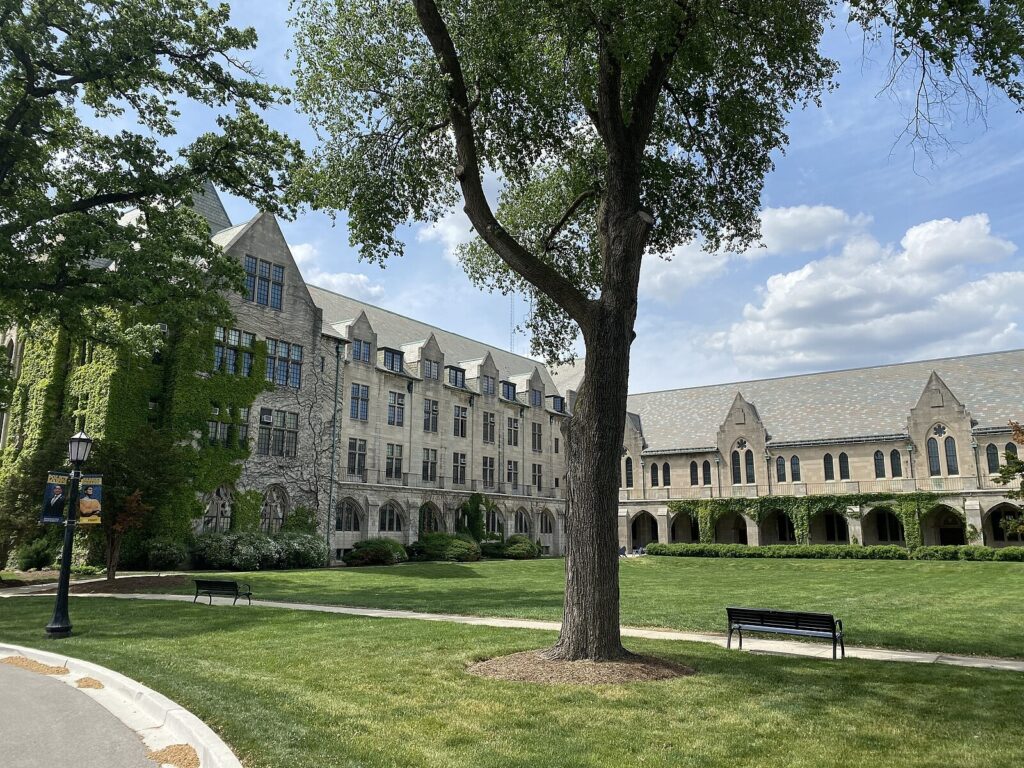
The university’s main home is a beautiful 30-acre wooded campus in River Forest, Illinois, just 10 miles west of downtown Chicago. This campus lets you study in a peaceful setting while staying close to Chicago’s many clinical and fieldwork options. You’ll find it at 7900 West Division Street, River Forest, Illinois 60305.
Being close to Chicago gives Dominican students a huge advantage. You can quickly reach countless social service agencies, healthcare facilities, community organizations, and government offices. These places often become field placement sites or future workplaces. The quiet suburban setting balances out the city’s energy and creates an ideal learning environment.
Dominican University has grown beyond its main campus to help students all over Chicago. Social work students can take Master of Social Work (MSW) classes at the University Center of Lake County, at 1200 University Center Drive in Grayslake, Illinois. This northern location makes advanced education available to professionals throughout the region.
Students who want to experience city life can study at Dominican’s Chicago campus. It’s part of The Resurrection Project’s La Casa Residence Hall in Pilsen. This modern six-story building offers apartment-style living in a dynamic community. The campus sits at 1805 S. Paulina Street, Chicago, Illinois 60608, right in one of Chicago’s most culturally rich neighborhoods. You’ll have direct access to diverse communities and social work opportunities.
The Pilsen location offers more than just housing. It includes Resource Center facilities where you can see urban social work in action and develop culturally aware intervention strategies. You’ll work directly with community members and organizations that tackle real-life social challenges.
The university also partners with Triton College at 2000 Fifth Avenue in River Grove, Illinois. While this location doesn’t offer social work programs, it provides related courses like the Bachelor of Arts in Human Services. Many students use this program as a stepping stone to advanced social work education.
Dominican University’s multiple campuses show its dedication to being available and involved in communities. Social work students get more options for field placements and can work with different population groups. You’ll learn to help clients in urban, suburban, and rural settings – a valuable skill in social work.
Each location has modern facilities that support learning and professional growth. You’ll find tech-equipped classrooms, research tools, and spaces for group work. Faculty teach at all locations to ensure high-quality education at every campus.
Getting between campuses is easy with public transit and university shuttles. The main River Forest campus connects well with Chicago’s public transportation. These transport options help students without cars reach their field placements and use resources at different campuses.
The university’s campus locations create unique hands-on learning chances. From River Forest, you can join programs with suburban schools, hospitals, and community groups. The Chicago and Lake County locations connect you to urban and regional social services.
Graduate students in the MSW program find the Lake County location particularly helpful. This site offers advanced social work classes to northern suburb students who can’t easily reach the main campus. Working professionals especially appreciate this flexibility while balancing work and studies.
Every Dominican University location shares the same commitment to excellent social work education. The university’s teaching philosophy creates a unified experience across all campuses. This approach helps Dominican serve many different students while keeping classes small and personal at each site.
Dominican University’s School of Social Work gives you several ways to grow your career. You can choose from bachelor’s programs or graduate degrees that prepare you for different social work careers.
The university’s star program is their Master of Social Work (MSW), which teaches students to practice globally focused, relationship-centered social work. Full-time students can finish in two years, while part-time students take three to four years. Students with a Bachelor of Social Work from a CSWE-accredited school can complete their MSW in just nine months through the advanced standing option.
Students love the MSW program’s flexibility. You can study at the main River Forest campus, the University Center of Lake County in Grayslake, or online. This setup works great for professionals and people with families. The coursework can be done entirely online, but field placements might need some in-person time since fully remote options aren’t available yet.
Regular MSW students must complete 60 semester credit hours through 20 courses. The detailed curriculum has:
- Required coursework in relationship-centered, community-based, and global social work
- Mental health, human behavior, and diversity studies
- Elective courses (which may include requirements for specialized focus areas)
- 1,080 hours of supervised practice in partnering social service agencies
- Related field practicum courses
Advanced standing students need 30 credit hours (10 courses), including field practicum. Everyone must finish within six years of starting.
Students can choose from six specialized tracks within the MSW program to build expertise in high-demand areas that match their career goals.
Dominican University also offers exciting combined degree programs to expand your career options:
MSW/MBA dual degree opens doors in fields where you can make a real difference. You’ll learn both clinical social work and business management – skills that leaders need in nonprofits, healthcare administration, and social enterprises.
MSW/MLIS program helps you become a leader in two fields that value equity, welfare, and social justice. This combination works well for roles in community resource centers, information services for underserved populations, and educational settings.
MSW/MMCR program meets the growing need for professionals who understand both social work and conflict resolution. This expertise helps you handle disputes in family services and community organizations.
School social workers can benefit from Dominican’s School Social Work Endorsement program. You’ll learn to promote positive change in schools by working with students, families, and educators.
The university’s Bachelor of Social Work (BSW) program starts your career in this fast-growing field. BSW students must pick a minor in areas like sociology, psychology, or criminal justice. You can also earn both a BSW and a BA or BS in related fields within four years. Dual degree students don’t need to choose a minor.
The Council on Social Work Education’s Board of Accreditation has fully accredited the MSW program. This tells employers and students that the program meets professional standards.
MSW graduates leave Dominican University ready to be skilled, practiced, and caring social workers. The program blends global perspectives with expert teaching and diverse field experiences to give you exceptional preparation for success.
Field education at Dominican University
Practical experience is the foundation of Dominican University’s social work education. The Council on Social Work Education calls field education “the signature pedagogy” of social work training. Dominican’s hands-on learning component combines classroom theory with ground practice. Students develop vital professional skills through guided experience.
Dominican University’s field education uses a well-laid-out yet flexible approach that works for different learning needs. Master of Social Work (MSW) students must complete two distinct practicum experiences. The Generalist (first) year needs a minimum of 400 hours over the academic year – about 14 hours weekly. The Advanced Generalist (second) year needs 500 hours – roughly 17 hours weekly. These requirements help students gain substantial experience without overwhelming their studies.
Students start their practicum placement journey early. The Social Work Practicum Education Office welcomes eligible students to join an online Canvas site in January. The site helps them through the “Social Work Practicum Readiness” process. Students work on their resumes, cover letters, practice interviews, and get tailored guidance from experienced field education staff. This complete preparation helps them build professional skills to secure meaningful placements that line up with their career goals.
Dominican University has developed mutually beneficial alliances with over 300 agencies throughout Cook, Lake, and surrounding counties. These organizations share the university’s steadfast dedication to social justice and serve marginalized populations. The network offers exceptional placement options in practice settings of all types:
- First-year placements build foundational skills in engagement, assessment, case management, and resource referrals
- Second-year placements line up with specialized tracks including School Social Work, Children, Youth and Families, Health and Well-being, Military Social Work, Global track, and Aging, Adulthood, and Gerontology
School social work enthusiasts can get specialized field experiences at Dominican that meet Professional Educator License requirements in Illinois. These placements need 600 hours (about 20 hours weekly) and run through June. They follow the school calendar instead of the university’s academic schedule. Students develop specialized skills in resource brokering, school climate improvement, multi-level interventions, and trauma-informed mental health services.
Dominican University stands out by offering international field education options. MSW students can choose international placements during their Advanced Generalist year as part of the Global Social Work track. These 10-week experiences let students practice social work in different national and cultural contexts. They enhance skills in critically reflexive, anti-oppressive, and human rights practice. Past internships have taken place in Ecuador, India, Ireland, Latvia, Mexico, and South Africa.
The university understands that many students juggle work and education. Dominican allows employment-based field placements for students working in social service settings. These arrangements create clear educational boundaries between employment and internship duties to protect the learning experience.
Dominican provides complete support throughout field placements. Students work with experienced agency practicum instructors who guide their professional growth. University field liaisons keep regular contact to track progress and help with placement challenges.
Field education enhances academic coursework in meaningful ways. The university states, “It is in social work practicum where students will demonstrate their growing competencies as social workers”. Theory and practice come together in an all-encompassing approach that prepares students to serve professionally after graduation.
The program follows a relationship-centered, globally focused approach that matches the university’s social work philosophy. Students combine deep academic study with civic engagement in Chicago organizations and beyond. This unique approach helps them develop skills to tackle complex social issues at multiple practice levels.
Accelerated BA/MSW students can work in prestigious settings like the Chicago Commission on Human Relations, Chicago Public Defender’s Office, Cook County Circuit Court, Municipal Police Departments, and the Social Security Administration. These placements offer valuable networking alongside hands-on experience.
Online MSW students should note that while they can complete coursework remotely, field placements require in-person participation. All the same, Dominican helps students in Illinois, Indiana, Michigan, Wisconsin, and Iowa find suitable placement opportunities.
The school maintains high field education standards. Students need a minimum 3.0 GPA before starting field practicum. They must earn at least a “B” in their field practicum and related practice courses to move to later placements. These standards ensure every student is ready for professional practice responsibilities.
What sets Dominican University apart?
Dominican University’s social work programs stand out from other educational options in several ways. The university blazed a trail in progressive social work education as one of the first graduate schools nationwide to offer a family-centered concentration with a global focus. This innovative path sets you up for a career with remarkable growth potential. The Bureau of Labor Statistics shows social work jobs are projected to grow 6% from 2024 to 2034, way faster than most careers.
The Sinsinawa Dominican tradition’s deep commitment to truth and compassionate service forms the backbone of Dominican University’s School of Social Work. This core philosophy shapes the curriculum and creates an environment where students develop professional skills while building strong ethical foundations.
Students at Dominican get the personal attention they need. Faculty members take a genuine interest in your success and provide one-on-one support throughout your studies. This student-first approach means you’ll get guidance that fits your career goals and learning style.
Dominican’s MSW program adapts to your life with multiple study options:
- Two-year full-time program
- Three or four-year part-time tracks
- Nine-month advanced standing option (for BSW holders)
The program becomes even more accessible with courses available at the River Forest campus, University Center of Lake County, or online. You can advance your education whatever your location or schedule.
Global perspectives run deep in classroom teaching and field work at Dominican. Students can take part in international internships across the world:
- Ecuador
- India
- Ireland
- Latvia
- Mexico
- South Africa
The school now features a special 10-week placement in Uganda. These worldwide opportunities let you experience social work in different cultural contexts and boost your professional versatility.
Family-centered learning sets this program apart. The curriculum looks at families through cultural, community, life cycle, and systems perspectives. This broad view prepares you to help at every level, from working with individuals to leading community change.
Dominican goes beyond standard MSW courses with specialized tracks for specific career paths. The global track teaches you to work with transnational populations, especially trauma-affected immigrants and refugees. You’ll learn about migration, resettlement challenges, displacement effects, cultural imperialism, and transnationalism—and how they affect mental health and well-being.
The university aims to lead global social work through evidence-based education, ethical practice, and positive social change. This forward-looking approach prepares you to advance the field through thoughtful leadership and informed practice.
The MSW program’s full accreditation from the Council on Social Work Education’s Board of Accreditation proves its quality. Employers value this accreditation as proof of program excellence and graduate competence.
Dominican prepares culturally aware practitioners who champion human rights and advocate for social, economic, and environmental justice. This focus on advocacy sets the program apart from typical clinical programs, creating graduates ready to tackle both systemic issues and individual needs.
The student body reflects the school’s commitment to diversity. Graduate students come from various backgrounds—43.32% Hispanic/Latino, 17.05% Black or African American, 29% White or Caucasian, and 3.23% Asian. This mix of perspectives enriches classroom discussions and professional growth.
Faculty members bring expertise in human trafficking, domestic violence, gerontology, school social work, and child welfare. You’ll learn from teachers who combine academic knowledge with real-world experience in key areas of modern social work.
Dominican University’s social work programs blend academic excellence with practical skills, global awareness with local action, and professional expertise with ethical practice. This creates a unique learning experience that prepares you to make a real difference in communities everywhere.
Next steps
Thinking about joining Dominican University’s social work program? Here’s what you need to know about deadlines, requirements, and processes that will help you succeed.
Application Deadlines
Early applications give you the best advantages during admission. MSW programs have priority deadlines you should know – full-time students need to apply by April 15, while part-time students have until August 14. Students who apply early get first consideration for scholarships and better chances at internship placements, which open in February/March.
The program cannot guarantee internships for students who apply after May 15. Students who submit applications after this date and receive acceptance might need to switch from full-time to part-time status if they can’t secure an internship.
Advanced standing applicants (those with a BSW from a CSWE-accredited program) must follow these same deadlines. Short Term Approval applicants must apply by May 1.
International Student Requirements
International students must complete both the general admission application and extra visa requirements. The main difference is that F-1 and J-1 visa holders cannot enroll in Dominican’s online MSW program – they must choose in-person study. These students must also follow their advisor’s academic plan exactly, or risk losing their visa status.
International applicants must meet these deadlines:
- Summer Start: March 11 (documents for I-20 due by April 1)
- Fall Start: July 1 (documents for I-20 due by July 31)
- Spring Start: November 11 (documents for I-20 due by November 18)
Transfer Credits & Student-at-Large Options
Students can take up to four MSW courses as a Student-at-Large before formal admission. This option lets you learn about the program without full commitment, and you can apply these credits to your degree after admission.
Students with previous graduate coursework can transfer up to six semester hours toward their MSW if they earned at least a B in those courses. The School of Social Work director must review and approve transfer requests before admission.
Dual Degree Applications
Students interested in combined programs (like MSW/MBA, MSW/MMCR, or others) need separate applications and must meet admission standards for both programs. Current students who want to transfer into a dual degree program need a 3.0 GPA minimum and must meet all admission requirements for the second program.
Timeline Expectations
The program timeline varies by enrollment type:
- Full-time MSW students complete 60 credit hours in four continuous semesters (two years)
- Part-time MSW students finish in eight semesters (three calendar years)
- Advanced standing students complete 30 credit hours in nine months (full-time) or two years (part-time)
Students can switch from full-time to part-time status, but not the reverse. All students must finish their degree within six years of starting the program.
Dominican University offers many resources to help you succeed – from career development services to academic support, personal counseling, and financial assistance.